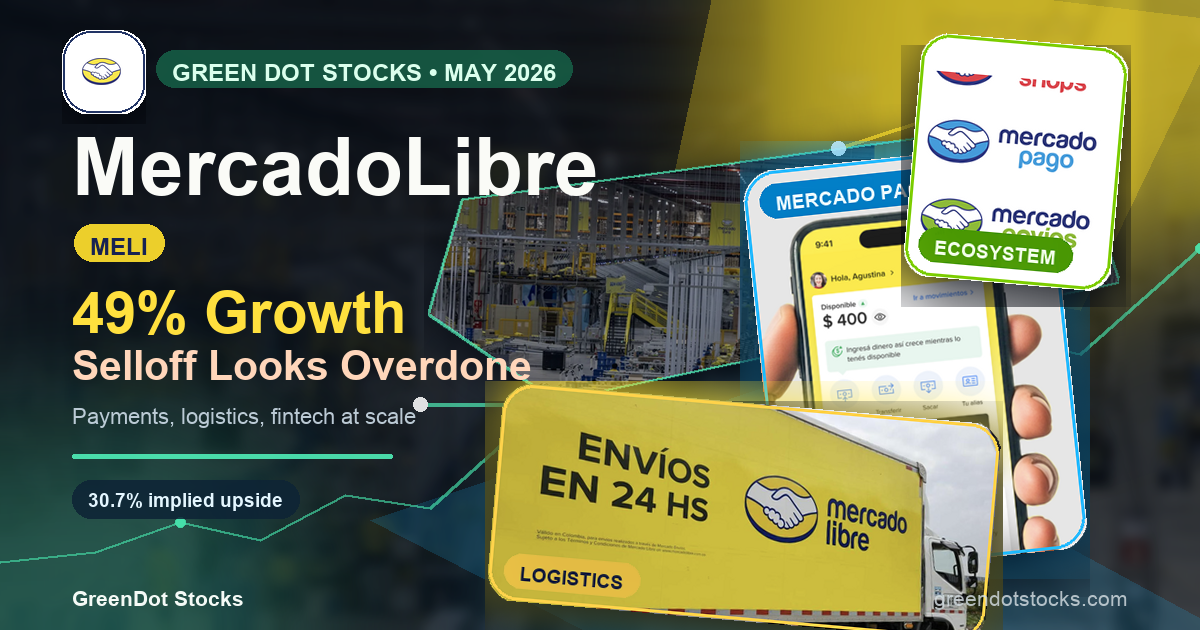
MercadoLibre (MELI) is often called the Amazon of Latin America, but that label misses most of the point. MercadoLibre is also a payments network, a logistics operator, an advertising platform, a credit business, and increasingly a day-to-day financial operating system for consumers and small businesses across the region.
What makes that so attractive for investors is where the company operates. MercadoLibre spent years building in markets where shipping, digital payments, formal credit, and trust between buyers and sellers could all be weak links. When one company solves all of that, it stops looking like a website and starts looking like infrastructure. That is why the stock is still compelling after the recent selloff. Shares have been pressured by first-quarter margin compression and analyst target cuts, but GreenDot Stocks still rates MercadoLibre as a green dot business and undervalued on the screen.
What MercadoLibre Actually Does
The easiest way to understand MercadoLibre is to stop thinking of it as an online store and start thinking of it as a regional commerce and financial engine. MercadoLibre operates e-commerce platforms in 18 countries and Mercado Pago, its fintech arm, in eight. The marketplace is still the front door most investors recognize, but the real strength is in everything wrapped around it.
On the commerce side, sellers can list products, buy ads, tap fulfillment, ship through Mercado Envios, and use a network of drop-off and pick-up points that helps the company manage a region where logistics can be a competitive nightmare. On the fintech side, consumers and merchants can use digital wallets, debit cards, credit cards, QR payments, merchant acquiring, savings tools, insurance, and loans. The real point is that all of these pieces reinforce one another. Sellers are pulled toward Mercado Pago, Mercado Envios, and Mercado Ads; consumers can shop, pay, finance purchases, and manage money in one place; and every extra touchpoint gives MercadoLibre more data about demand, fraud, risk, and reliability.
Why The Opportunity Is So Large
The long-term bull case starts with a simple point: Latin America is still earlier in its digital commerce and fintech development than many investors instinctively assume. E-commerce penetration still lags markets like the United States, the United Kingdom, and China, while digital financial adoption still has years of runway ahead of it.
That is not abstract corporate language. More than 9.5 million entrepreneurs and small businesses operate within the ecosystem, and 95,000 SMEs use Mercado Pago as a payment tool, with 79% reporting a drop in cash usage after adopting digital payments. MercadoLibre is not just capturing spend that was already digital. In many cases, it is helping create the digital habits in the first place, which is why the ecosystem keeps widening beyond retail.
That is why the company can look like several good businesses stacked on top of each other. The marketplace benefits from payments and logistics. Payments benefit from marketplace volume and offline merchant adoption. Credit benefits from proprietary first-party data across both. Advertising benefits from high-intent traffic. Each layer deepens the moat of the others.
The Business Is Still Growing At A Remarkable Pace
The market may be nervous, but the operating numbers still look exceptional. Net revenues and financial income rose to $8.845 billion, up 49% year over year. Gross merchandise volume rose 42% to $18.951 billion. Total payment volume increased 50% to $87.186 billion. Fintech monthly active users climbed to 83 million from 64 million a year earlier, while unique active buyers rose to 84 million from 67 million.
Those are not the numbers of a company running out of room.
Commerce revenue grew 47.4% in the quarter, while fintech revenue grew 51.1%. Brazil remained the largest engine, but Mexico also posted very strong growth, particularly in fintech. The company is not leaning on one narrow lever. It is growing across the marketplace, payments, and credit layers at the same time.
The consistency has been striking too. MercadoLibre reached 28 consecutive quarters of revenue growth above 30% year over year. Even with heavy investment, full-year 2025 adjusted free cash flow was $1.481 billion, and first-quarter 2026 operating cash flow reached $2.075 billion. This is not a fragile growth story that only works while outside capital is cheap.
Why The Market Is Worried Right Now
The reason the stock sold off is not hard to understand. MercadoLibre is investing aggressively, and those investments are showing up in margins. First-quarter gross margin fell to 43.7% from 46.7% a year earlier, and operating margin dropped to 6.9% from 12.9%. The biggest drivers were the lower free-shipping threshold in Brazil, higher shipping operating costs, more first-party sales, and a large jump in credit-related provisions.
That last point is important. Provision for doubtful accounts more than doubled to $1.244 billion in the quarter, up 106.5% year over year, largely because originations grew 81%, especially in credit cards and consumer lending. Gross loans receivable rose to $14.555 billion at quarter end, up from $12.508 billion at the end of 2025. When a company expands credit that quickly, investors are right to ask whether future losses will eat more of the economics than management expects.
That is why several analysts cut targets after the quarter: growth is still excellent, but continued investment and lower visibility into margin recovery make the story harder to model in the near term.
That skepticism is fair. MercadoLibre is not a clean software model. Lower free-shipping thresholds can hurt commerce margins, and faster lending growth can raise future losses. The near-term question is whether the company is investing intelligently or simply making growth more expensive.
Why The Selloff May Still Be Missing The Real Story
The harder question is whether the market is mistaking near-term pressure for structural weakness. The disclosures still point the other way: user counts are rising, cash generation remains strong, and the company is investing from a position of leadership, not scrambling to stay relevant. Management also highlighted record Net Promoter Scores across commerce and fintech in Brazil, Mexico, Argentina, and Chile during 2025, which suggests the investments are deepening the user experience rather than papering over a deteriorating franchise.
Leadership continuity also looks solid. The planned transition from founder Marcos Galperin to Ariel Szarfsztejn as CEO, with Galperin staying on as executive chairman, looks more like a handoff inside the same long-term culture than a strategic reset.
Most important, the core logic still looks intact. Better shipping drives conversion, better payments drive trust and frequency, better data improves underwriting, and better credit helps merchants and consumers spend more inside the ecosystem. If that flywheel is still strengthening, then today's lower margins may reflect moat building more than moat erosion.
Why It Still Looks Undervalued On GreenDot Stocks
This is where the GreenDot Stocks view is useful. The screen is not treating MercadoLibre as risk free. It is saying the market may be over-discounting temporary pressure relative to business quality.
Based on the latest GreenDot Stocks figures, MercadoLibre trades around $1,546.81 against a blended fair value of $2,020.91, implying 30.7% upside. That is compelling because the current GreenDot Stocks read still rates moat, recurring revenue, and management as green.
| Current GreenDot Stocks read | Value |
|---|---|
| Current share price | $1,546.81 |
| Blended fair value | $2,020.91 |
| Implied upside | 30.7% |
| Business quality read | Green dot business |
| Value read | Undervalued |
| Underlying quality checks | Moat, recurring revenue, and management all green |
To justify the current price, investors likely have to assume either that today's margin pressure will linger long enough to damage the franchise or that MercadoLibre's best growth years are behind it. The operating data does not make either case obvious.
MercadoLibre still looks exciting because it is becoming a deeper part of how commerce and money move through Latin America. Businesses like that rarely look cheap for long.
If you want to see how MercadoLibre compares with the rest of the current shortlist, visit the GreenDot Stocks screener.